
Welcome to the TeachFX Blog
Jordan School District: Feedback + Coaching + PD =Joy
With TeachFX, Jordan School District Mathematics Administrator Amy Kinder and her team are transforming teaching and learning across 62 schools.

Building Teacher Pipelines & Reinventing the Role of Teachers
Watch this conversation at ASU+GSV 2023 featuring TeachFX CEO Jamie Poskin, Presence CEO Kate Eberle Walker, Teach for America CEO Elisa Villanueva Beard, Study.com SVP of Social Impact Dana Bryson, and National University Professor of Education & Director of Social and Emotional Learning Cynthia Sistek-Chandler.

Howard High School of Technology: Building Student Talk in Post-Pandemic Classrooms
Hear Howard’s teachers and instructional leaders discuss the role that TeachFX plays in helping to foster the engaging learning experience each educator is committed to.

Cignition and TeachFX: Elevating Students’ Online Tutoring Experience
Cignition piloted TeachFX in their tutoring program with a diverse group of students in a suburban/rural school district in the southeastern United States.
Through the TeachFX app, tutors gained a new lens into their sessions. They got an overview of student-tutor talk ratios, insights into their use of specific high-leverage teaching practices, and even word clouds depicting the academic vocabulary tutors and students used most frequently.

Inspiration for Teacher Appreciation Week (and did someone say food truck lunch party?)
Teacher Appreciation Week runs May 8th through May 12th. Let’s show our appreciation for the hardworking individuals who dedicate their lives to fostering the love of learning for our kids. Check out some ways which you can celebrate your teachers - and, enter to win a food-truck lunch party, courtesy of TeachFX.

Supporting Teaching Practice With AI-Powered Instructional Feedback
Teacher recruitment and retention are at crisis levels. The challenges we face weren’t created by the pandemic – they were compounding for decades. The solutions will require us to explore and embrace new ways of thinking, new ways of teaching, and new ways of supporting our teachers.

Atlanta’s Continental Colony Elementary School: More Conversational & Equitable Classrooms
Dr. Kristen Horton and her leadership team are committed to a vision for more conversational and equitable classrooms. They know the two are inextricably linked with each other and with their ultimate mission of providing a high-quality education for every child. She immediately saw TeachFX as a simple way to help teachers reflect on their own by providing meaningful feedback. And, that with TeachFX, feedback is provided in a way that doesn’t feel quite so high-stakes as classroom observations can.

St. Cecilia in Dallas: Launching New Data-Informed PD With EANS + ClassWallet
Instructional Coach, Dra. Diana Torres Rivera first used TeachFX in her own classroom at St. Cecilia’s. Over the course of a semester, she recorded a number of her own lessons, in both her English and Spanish classes.
This eventually lead to St. Cecilia using funds through the Emergency Assistance for Non-Public Schools (EANS) to launch a partnership with TeachFX
And now that TeachFX is an approved vendor on ClassWallet, your private school might be able to do the same!

Utah STEM Action Center Grant Applications Due 3/31
✴️ Grant applications due 3/31 ✴️ The Utah STEM Action Center's grant program supports thousands of Utah's teachers with valuable curricula and teaching practices. Their grants provide schools and districts with funding support for instructional coaching, mentoring, self-reflection, and effective professional learning communities (PLCs).
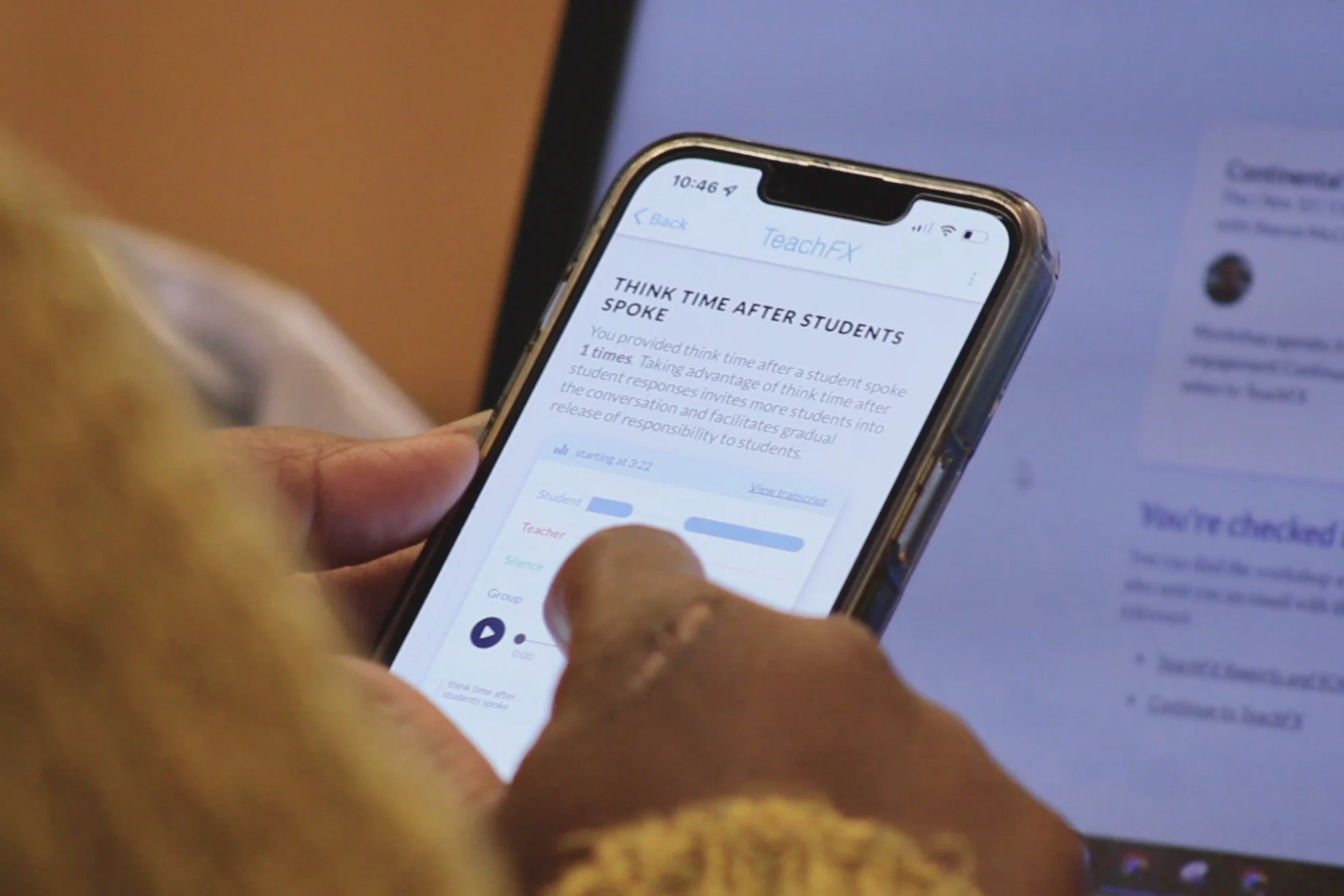
How much “Think Time” did you give your students today?
According to research, a teacher typically waits less than one second for a student response after asking a question. Similarly, after a student responds, teachers respond with another question in less than one second. Providing students with at least 5 seconds of Think Time has tremendous benefits:
Increased length of student responses.
Increased the number of unsolicited student responses.
Increased speculative responses.
Decreased number of students failing to respond.
Increased number of responses from student with learning exceptionalities.