Instructional Leadership

The Power of Reflection and Feedback to Drive Instructional Leadership

The Power of Reflection and Feedback to Drive Instructional Leadership

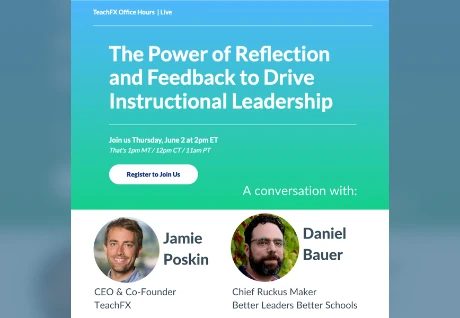
TeachFX Office Hours | The Power of Reflection and Feedback to Drive Instructional Leadership Featuring Daniel Bauer, Chief Ruckus Maker of Better Leaders Better Schools and Jamie Poskin, CEO and co-founder of TeachFX — and k12 leaders from around the nation
The Power of Reflection and Feedback to Drive Instructional Leadership

The Power of Reflection and Feedback to Drive Instructional Leadership

TeachFX Office Hours | The Power of Reflection and Feedback to Drive Instructional Leadership Featuring Daniel Bauer, Chief Ruckus Maker of Better Leaders Better Schools and Jamie Poskin, CEO and co-founder of TeachFX — and k12 leaders from around the nation

The Power of Reflection and Feedback to Drive Instructional Leadership

The Power of Reflection and Feedback to Drive Instructional Leadership

TeachFX Office Hours | The Power of Reflection and Feedback to Drive Instructional Leadership Featuring Daniel Bauer, Chief Ruckus Maker of Better Leaders Better Schools and Jamie Poskin, CEO and co-founder of TeachFX — and k12 leaders from around the nation

Building Teacher & Instructional Leadership Capacity With Personalized PD

Building Teacher & Instructional Leadership Capacity With Personalized PD

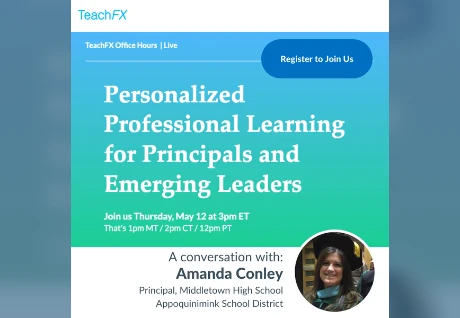
TeachFX Office Hours | Dr. Amanda Conley discusses a first-year principal’s perspective on evolving as an instructional leader, how principals can provide compassionate and candid feedback that helps teachers advance their instructional practices, and how partnering with TeachFX has helped Amanda and her teachers with personalized PL and the objective feedback provided via the TeachFX app.

Building Teacher & Instructional Leadership Capacity With Personalized PD

Building Teacher & Instructional Leadership Capacity With Personalized PD

TeachFX Office Hours | Dr. Amanda Conley discusses a first-year principal’s perspective on evolving as an instructional leader, how principals can provide compassionate and candid feedback that helps teachers advance their instructional practices, and how partnering with TeachFX has helped Amanda and her teachers with personalized PL and the objective feedback provided via the TeachFX app.

Building Teacher & Instructional Leadership Capacity With Personalized PD

Building Teacher & Instructional Leadership Capacity With Personalized PD

TeachFX Office Hours | Dr. Amanda Conley discusses a first-year principal’s perspective on evolving as an instructional leader, how principals can provide compassionate and candid feedback that helps teachers advance their instructional practices, and how partnering with TeachFX has helped Amanda and her teachers with personalized PL and the objective feedback provided via the TeachFX app.

Integrating Innovation and Change

Integrating Innovation and Change

Why is it so difficult for schools to make positive change? Education historian Larry Cuban finds that few school reform efforts over the past century have had much effect on what teachers do and how students experience school. Through our partnerships, TeachFX takes a different approach.

Integrating Innovation and Change

Integrating Innovation and Change

Why is it so difficult for schools to make positive change? Education historian Larry Cuban finds that few school reform efforts over the past century have had much effect on what teachers do and how students experience school. Through our partnerships, TeachFX takes a different approach.

Integrating Innovation and Change

Integrating Innovation and Change

Why is it so difficult for schools to make positive change? Education historian Larry Cuban finds that few school reform efforts over the past century have had much effect on what teachers do and how students experience school. Through our partnerships, TeachFX takes a different approach.

What is school for?

It seems we’ve fully moved on from talking about getting our schools and our students back to normal. There is no back. And, if we’re honest, there has never been a “normal.” There’s only change. And as we navigate this constant – and constantly accelerating – change, many of us are now asking: What is school for? Have you been wrestling with this question, too?

What is school for?

It seems we’ve fully moved on from talking about getting our schools and our students back to normal. There is no back. And, if we’re honest, there has never been a “normal.” There’s only change. And as we navigate this constant – and constantly accelerating – change, many of us are now asking: What is school for? Have you been wrestling with this question, too?

What is school for?

It seems we’ve fully moved on from talking about getting our schools and our students back to normal. There is no back. And, if we’re honest, there has never been a “normal.” There’s only change. And as we navigate this constant – and constantly accelerating – change, many of us are now asking: What is school for? Have you been wrestling with this question, too?

How to generate deeper learning with instructional conversations

How to generate deeper learning with instructional conversations

Experimental research (Saunders & Goldenberg, 2009) demonstrates that students who talk more learn more when that talk is focused on higher-order thinking. Here, we explore three talk moves teachers can try to help facilitate instructional conversations that support higher-order thinking.

How to generate deeper learning with instructional conversations

How to generate deeper learning with instructional conversations

Experimental research (Saunders & Goldenberg, 2009) demonstrates that students who talk more learn more when that talk is focused on higher-order thinking. Here, we explore three talk moves teachers can try to help facilitate instructional conversations that support higher-order thinking.

How to generate deeper learning with instructional conversations

How to generate deeper learning with instructional conversations

Experimental research (Saunders & Goldenberg, 2009) demonstrates that students who talk more learn more when that talk is focused on higher-order thinking. Here, we explore three talk moves teachers can try to help facilitate instructional conversations that support higher-order thinking.

Creating meaningful alternatives to teacher evaluation

Creating meaningful alternatives to teacher evaluation

Veteran teachers and their school site administrators share a common challenge: how to make teacher evaluation more meaningful, less tense…

Creating meaningful alternatives to teacher evaluation

Creating meaningful alternatives to teacher evaluation

Veteran teachers and their school site administrators share a common challenge: how to make teacher evaluation more meaningful, less tense…

Creating meaningful alternatives to teacher evaluation

Creating meaningful alternatives to teacher evaluation

Veteran teachers and their school site administrators share a common challenge: how to make teacher evaluation more meaningful, less tense…